

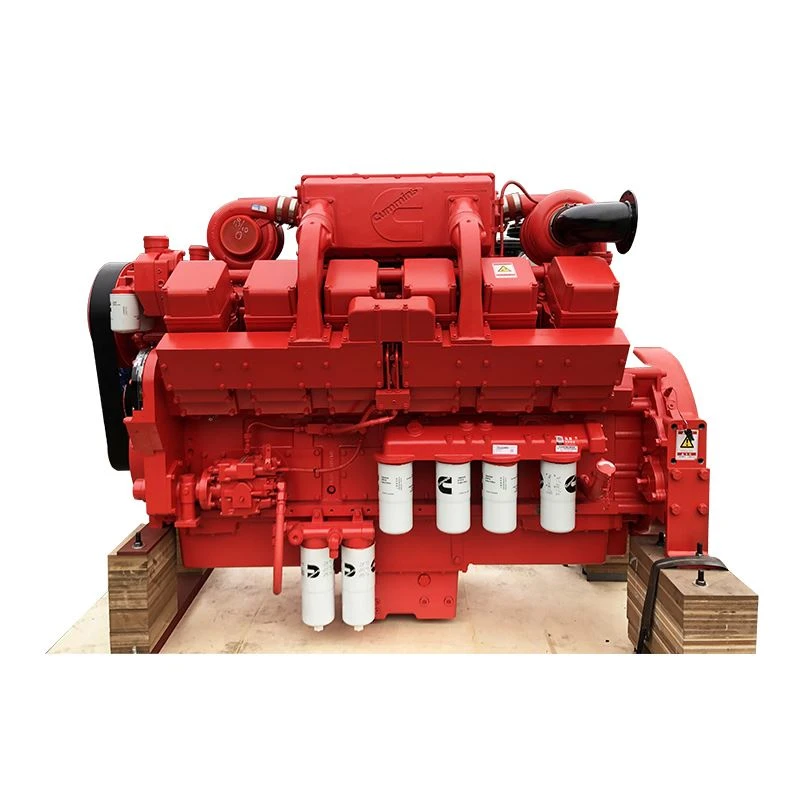
A four-cylinder turbocharged diesel engine is a compact internal-combustion engine that uses forced induction and high-pressure fuel injection to deliver high torque from a small displacement.
Technical Specifications
|
Specification |
Value |
|
Engine Configuration |
Inline 4-cylinder, 4-stroke, liquid-cooled diesel |
|
Displacement |
1,995 cc (2.0 L) |
|
Bore × Stroke |
84.0 × 90.0 mm |
|
Rated Power |
140 kW (188 hp) @ 4,000 rpm |
|
Maximum Torque |
400 Nm @ 1,750–2,500 rpm |
|
Maximum Engine Speed |
4,800 rpm |
|
Compression Ratio |
16.5:1 |
|
Valvetrain |
DOHC, 16 valves |
|
Fuel Injection |
Common Rail Direct Injection (CRDi), up to 2,200 bar |
|
Turbocharging |
Variable Geometry Turbocharger (VGT) |
|
Charge Air Cooling |
Air-to-water charge air cooler, 1.8 bar boost |
|
Aftertreatment |
EGR + DOC + DPF + SCR, AdBlue compatible |
|
Dimensions (L × W × H) |
650 × 610 × 720 mm |
|
Dry Weight |
165 kg |
|
Fluid Capacities |
Engine oil: 5.5 L; Coolant: 7.5 L |
PTO & Mounting Configurations
Flywheel Housing Options: Standardized SAE #3 and SAE #4 housing options for flexible alternator coupling.
Flywheel Connections: Compatible with 8.5-inch and 10-inch flexible drive plates in accordance with ISO 3046 standards.
Power Take-Off (PTO): Gear-driven auxiliary front PTO supplying up to 120 Nm torque for hydraulic pumps or cooling fans.
Crankshaft PTO Extension: Standard cylindrical keyed or splined shaft stubs for industrial pump drives.
Turbocharging & Fuel Injection System
High-pressure fuel injection optimizes fuel atomization and reduces particulate buildup.
VGT continuously adjusts vane geometry to eliminate turbo lag at lower RPMs.
An air-to-water intercooler maintains intake temperatures below 45°C, preventing thermal power derating under continuous high loads.
Operating Conditions & Duty Ratings
Prime Power Rating (PRP):
Continuous operation under variable load with a 10% overload capability for 1 hour per 12 hours.
Emergency Standby Rating (ESP):
Maximum power delivery during utility outages up to 200 operating hours annually.
Continuous Power Rating (COP):
Constant 100% load operation for utility base-load applications.
Specific Fuel Consumption:
198 g/kWh fuel consumption at 75% load operating point.
OEM Custom Options
• Private-label engine nameplates with laser-etched OEM branding and serial numbers.
• Custom ECU wiring harness lengths with optional IP67-rated waterproof connectors.
• Custom powder coating for engine blocks and mounting frames in OEM RAL colors.
Quality Control & Performance Verification
100% Dynamometer Testing: Every engine undergoes a multi-stage load test on a digital dynamometer before packing.
Pressure Leak Testing: 100% pneumatic leak checks conducted on oil, coolant, and fuel circuits.
Electrical System Inspection: ECU sensor calibration, harness continuity testing, and automated safety shutoff validation.
Inspection Traceability: Test logs recorded by engine serial number and archived for customer audit upon request.
Commercial Terms
MOQ: 5 units for standard engine configurations; 20 units for customized OEM specifications.
Production Lead Time: 15–20 business days for standard units; 30–35 business days for OEM orders.
Warranty Standard: 12 months or 2,000 running hours (whichever occurs first), full factory warranty.
Export Packaging: Heat-treated ISPM-15 wooden crates with internal VCI anti-corrosion barrier film wrapping.


FAQ
Q: Which duty rating does the published 140 kW rated power correspond to?
A: The 140 kW rating corresponds to Prime Power (PRP). Continuous Power (COP) output is approximately 127 kW, while Emergency Standby Power (ESP) allows a short-term peak of up to 154 kW.
Q: What emissions standard does the EGR+DOC+DPF+SCR aftertreatment package meet?
A: This aftertreatment configuration is calibrated to meet EU Stage V and US EPA Tier 4 Final emissions standards, with AdBlue consumption rated at approximately 3-5% of diesel fuel consumption.
Q: What types of equipment is this engine typically matched to?
A: This engine platform is most commonly matched to generator sets in the 100-150 kVA range, as well as mid-size water pump sets and hydraulic power units requiring the front PTO output.
Q: Can the engine be de-rated for use at high-altitude installation sites?
A: Yes, standard derating curves apply above 1,000 meters elevation, with turbocharger and ECU mapping adjustments available at order to maintain usable output at sites up to 3,000 meters.
Q: How quickly can critical spare parts be shipped internationally for units under warranty?
A: Critical components such as injectors and ECU sensors are dispatched via air freight within 48 hours of a confirmed order for units still under the standard warranty period.
Q: What is the difference between the 5-unit MOQ and 20-unit OEM MOQ requirement?
A: The 5-unit MOQ applies to standard catalog engine configurations, while the 20-unit threshold applies specifically to fully customized OEM builds involving non-standard ECU mapping, harness length, or branding requirements.


