

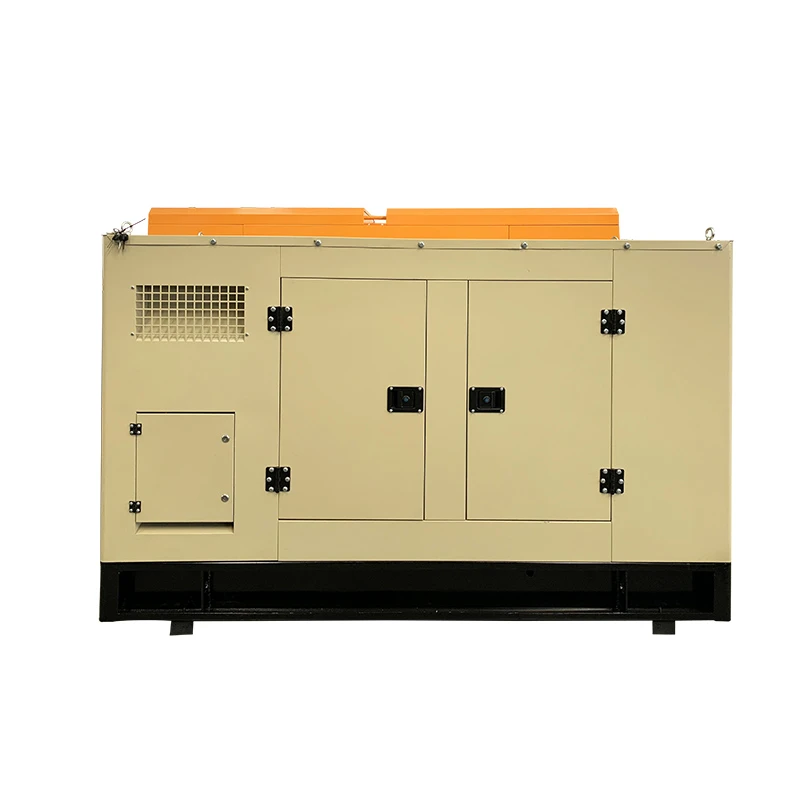
Diesel Whole Home Generator provides automatic backup power for residential loads, with configurable single- or three-phase output, 50/60Hz frequency, multiple voltage options, ATS integration, and diesel fuel configurations for different home power requirements.
Key Specifications
|
Item |
Specification |
|
Product Type |
Diesel Whole Home Generator |
|
Application |
Residential / Light-load standby |
|
Output Phase |
Single Phase / Three Phase |
|
Frequency |
50Hz / 60Hz |
|
Voltage |
220V / 380V / Multi-voltage |
|
Fuel |
Diesel |
|
Cooling |
Closed Water-Circulation Cooling |
|
Starting System |
24V Electric Start |
|
Controller |
DeepSea / SmartGen |
|
Enclosure |
Soundproof / Silent Type |
Automatic Transfer & Backup Operation
Automatic Backup Sequence
Utility failure → Generator starts automatically → ATS transfers the connected loads → Generator supplies backup power → Utility restores → ATS transfers back.
Utility Failure Detection
ATS monitors utility power and initiates the generator start sequence when a power failure is detected.
Load Transfer
ATS transfers only the connected household circuits to generator power after the generator reaches operating condition.
Controller & Electrical Matching
DeepSea or SmartGen controllers support automatic start/stop and ATS control. ATS configuration can be matched to the required voltage, frequency and phase.
Engine & Alternator
Diesel Engine Options
Cummins, Perkins, Weichai, Yuchai and Ricardo engines are available for different generator configurations.
Alternator Options
Stamford, Leroy Somer, Marathon and Mecc Alte alternators are available with brushless construction and AVR voltage regulation.
Engine Configuration
Water-cooled diesel engines are used for the generator sets, with engine selection matched to the required generator output.
Alternator Configuration
Alternator configuration can be specified according to output voltage, frequency and single- or three-phase requirements.
Diesel Fuel System
Integrated Fuel Tank: Standard integrated fuel tank configuration is available for on-site diesel storage and generator operation.
Extended Fuel Tank: Enlarged fuel tank options are available when longer operation between refueling is required.
External Fuel Connection: An external fuel connection can be specified for installations using a separate diesel storage tank.
Generator Sizing & Load Selection
Generator Sizing
Generator capacity should be selected based on the total continuous household load, motor starting demand and the loads required during a power outage.
Continuous Load
Add the running power of the household equipment intended to operate during an outage.
Starting Demand
Allow for the starting current of motor-driven equipment, especially HVAC compressors, heat pumps, well pumps and sump pumps.
Load Priority
Separate essential loads from non-essential loads when the generator is not intended to supply every household circuit simultaneously.
Capacity Selection
The selected generator rating should cover the required running load while allowing sufficient capacity for the highest applicable starting demand.
Installation Requirements
Installation Location: The silent enclosure is suitable for stationary outdoor installation; site layout should provide sufficient space for ventilation, exhaust discharge and routine service access.
Airflow & Cooling: The enclosure uses separated air-intake and exhaust paths to maintain radiator airflow and remove engine heat during operation.
Exhaust Routing: The exhaust outlet should be positioned to discharge engine exhaust away from the generator enclosure and building air intakes.
Foundation & Vibration: The generator engine and alternator are mounted on the steel base frame with rubber vibration isolators; the installation foundation should support the complete set and maintain level alignment.
Electrical Connection: Installation requires matching the generator output, voltage, frequency and phase configuration with the site electrical system and ATS arrangement.
Whole-Home Load Coverage
The generator can support refrigerators, lighting, internet and security systems, sump pumps and well pumps during a utility outage.
Central HVAC systems, heat pumps and other electrically driven heating and cooling equipment can be included according to their running and starting power requirements.
Water pumps, well pumps and other residential utility equipment can be powered when their operating and starting requirements are within the generator capacity.
Multiple household loads can operate together when the combined running load and starting demand remain within the generator's rated output.
Customization & Configuration
Power & Electrical: Customize output power, voltage, frequency, and single- or three-phase configuration.
Engine & Alternator: Select engine and alternator brands based on power and project requirements.
Control & ATS: Configure DeepSea or SmartGen controllers and ATS for automatic utility switching.
Fuel & Enclosure: Specify standard or enlarged fuel tanks and silent enclosure configurations.
Branding: Customize logo, nameplate, canopy color, and control-panel labeling for OEM orders.

Quality Control & Testing
Incoming Inspection: Engine, alternator, electrical components and structural materials are checked against specified models and assembly requirements before production.
Electrical Testing: Insulation resistance, wiring continuity, AVR function, voltage regulation, frequency stability and phase balance are verified before shipment.
Load Bank Testing: Each generator is tested at 25%, 50%, 75% and 100% load to verify output performance under different load conditions.
Protection Testing: Overload, low oil pressure and high coolant temperature protection functions are checked during factory testing.
Final Inspection: Fuel and cooling system leakage, battery/start system, noise level, appearance, labeling and packing are inspected before release.
FAQ
Q: What documents can be provided with a Diesel Whole Home Generator?
A: MST can provide product documentation such as the user manual, wiring diagram, test report and relevant compliance documents according to the order and destination market.
Q: What engine and alternator brands are available?
A: Engine options include Cummins, Perkins, Weichai, Yuchai and Ricardo; alternator options include Stamford, Leroy Somer, Marathon and Mecc Alte.
Q: Can spare parts be supplied after delivery?
A: Yes. Replacement parts can be supplied according to the generator model and engine/alternator configuration. Provide the model or component number when ordering parts.
Q: What information is required for a generator quotation?
A: Provide the required power, voltage, frequency, phase, application, destination market and any engine, alternator, ATS or fuel-tank preferences to confirm the configuration.
Q: Can the generator be supplied under a private label?
A: Yes. OEM orders can specify customer branding requirements such as logo, nameplate and canopy color.


