

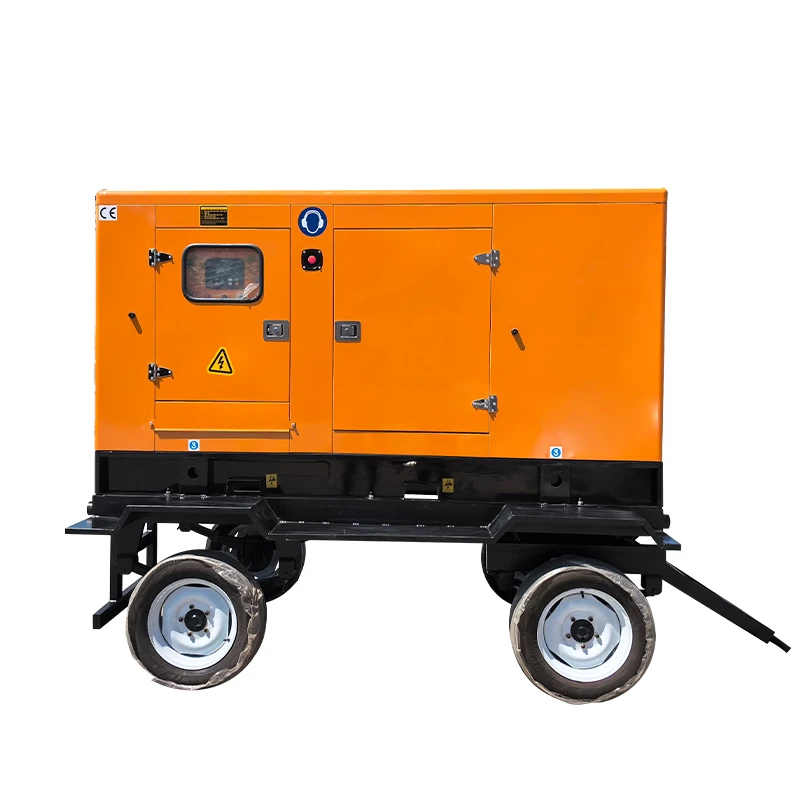
Standby Diesel Generator Set provides 200–2,500 kW standby power for commercial, industrial and critical facilities, combining a diesel engine, brushless alternator, digital controller and ATS interface for automatic backup power.
Key Specifications
|
Parameter |
Specification |
|
Standby Power |
200–2,500 kW |
|
Voltage |
Configured according to project electrical requirements |
|
Frequency |
50 / 60 Hz |
|
Phase |
3-phase |
|
Engine Speed |
1,500 / 1,800 rpm |
|
Engine |
Electronically controlled high-pressure common rail diesel engine |
|
Alternator |
Brushless, Class H insulation, PMG excitation |
|
Voltage Regulation |
±0.5% |
|
ATS Capacity |
100–4,000 A |
|
ATS Transfer Modes |
Open transition / delayed transition / closed transition |
|
Utility Monitoring |
3-phase voltage and frequency |
|
Re-transfer Delay |
0–30 minutes |
|
Short-Circuit Rating |
Up to 100 kA AIC |
|
Emission Options |
EPA Tier 4 Final / EU Stage V configurations |
|
Dimensions & Weight |
Vary by generator rating and enclosure configuration |
Automatic Standby Power System
Utility Failure → AMF Detection → Automatic Start → Generator Ready → ATS Load Transfer → Utility Recovery & Re-transfer
Utility Power Detection
The AMF control system monitors three-phase utility voltage and frequency and identifies power loss or abnormal mains conditions.
Automatic Generator Start
When utility power falls outside preset limits, the controller sends a start command to the diesel engine automatically.
Automatic Load Transfer
After generator voltage and frequency reach the required conditions, the ATS transfers the connected load from utility power to generator power.
Automatic Re-transfer
When utility power returns and remains stable, the ATS transfers the load back to the utility supply. A programmable 0–30 minute delay can be used before re-transfer, followed by generator cool-down and shutdown.
Generator Configuration & Control
Diesel Engine
The generator set uses electronically controlled, high-pressure common rail diesel engines, with engine selection matched to the required standby output.
Brushless Alternator
The alternator uses a brushless excitation system with Class H insulation and PMG excitation for the specified generator configuration.
Voltage Regulation
An automatic voltage regulator provides voltage regulation of up to ±0.5%, depending on the selected alternator and operating conditions.
Digital Controller
DSE or ComAp controllers can be specified for automatic operation, generator monitoring, alarm management and external system communication.
Control, Protection & Monitoring
Generator Protection
The control system monitors over/under voltage, over/under frequency, overload and short-circuit conditions.
Engine Protection
Protection functions monitor conditions such as low oil pressure, high coolant temperature, overspeed and starting faults.
ATS Configuration
ATS capacities from 100A to 4,000A are available, with open-transition, delayed-transition or closed-transition operation.
Remote Monitoring
Modbus RTU, Modbus TCP/IP and BACnet options are available for compatible building management and remote monitoring systems.
Fuel & Operating Configuration
For reference, a 1,000 kW configuration may consume approximately 205–215 L/h at rated standby load, depending on the selected engine and operating conditions.
Runtime depends on generator load, fuel tank capacity and site operating requirements. Fuel tank size can be specified according to the required backup duration.
Maintenance intervals follow the selected engine manufacturer's service schedule and depend on oil specification, fuel quality, ambient conditions and operating profile.
Installation & Configuration Options
Electrical Configuration
Voltage, frequency, phase arrangement, circuit breaker and ATS capacity can be specified according to the facility distribution system.
Enclosure Configuration
Open, soundproof, weatherproof and containerized configurations can be selected according to installation location and protection requirements.
Site Conditions
Cooling, ventilation, exhaust, weather protection and other installation-related requirements can be adjusted according to the site environment.
Applications
Backup power for IT loads, cooling systems, network infrastructure and other critical facility systems.
Emergency power for medical equipment, life-safety systems and essential building services during utility outages.
Production equipment, process controls, pumps and other loads where power interruption can affect operations.
Offices, hotels, commercial buildings, water facilities and infrastructure systems with automatic transfer requirements.
Quality Control & Factory Testing
Component Inspection
Engine, alternator, controller, ATS components and major electrical assemblies are checked against the approved product configuration.
Assembly Inspection
Mechanical fasteners, fuel connections, cooling components, exhaust connections and electrical wiring are inspected during final assembly.
Electrical & Functional Testing
Voltage, frequency, AVR operation, starting, alarms, protection functions and control sequences are checked before shipment.
Factory Acceptance Test
A 4-hour FAT can be conducted using resistive and reactive load banks, with test points from 25% to 110% load according to the agreed test procedure.

FAQ
Q: What is the standard production lead time?
A: Standard production is 8–10 weeks from technical drawing approval. Ready-to-ship stock may be available for selected standard models.
Q: Does the generator meet current emissions requirements?
A: Configurations are available with EPA Tier 4 Final and EU Stage V emissions compliance, using SCR and DPF aftertreatment where required.
Q: Can maintenance filters be sourced locally?
A: Standardized maintenance interfaces support oil filters, air elements and fuel-water separators compatible with commonly available Fleetguard, Donaldson and Baldwin part numbers.
Q: What warranty is provided?
A: Standby installations include a 5-year or 3,000-operating-hour factory warranty, subject to the selected project configuration and applicable warranty terms.
Q: What documents are available for project approval?
A: Depending on the configuration and destination, documentation can include CE declarations, UL2200 compliance documents and ISO 8528-related test documentation.
Q: Can the generator be configured for specific site conditions?
A: Yes. Electrical configuration, enclosure, cooling, ventilation, exhaust and other site-related requirements can be specified according to the project conditions.


