

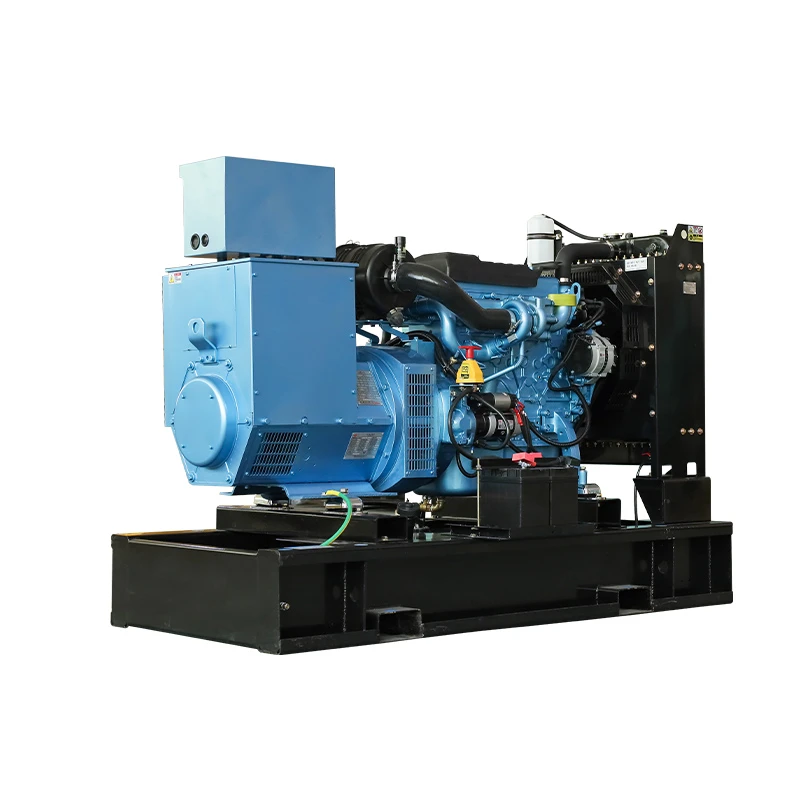
Cummins Diesel Standby Generator Set provides backup power for defined critical electrical loads during utility grid failures. The 500 kVA / 400 kWe standby configuration uses a Cummins QSX15-G8 diesel engine, Stamford HC5C alternator and Cummins PowerCommand 3.3 controller, with 400/230 V three-phase output at 50 Hz.
Technical Specifications
|
Item |
Specification |
|
Standby Power |
500 kVA / 400 kWe |
|
Prime Power |
450 kVA / 360 kWe |
|
Voltage |
400/230 V |
|
Phase |
3 Phase |
|
Frequency / Speed |
50 Hz / 1500 rpm |
|
Power Factor |
0.8 |
|
Current |
722 A |
|
Performance Class |
ISO 8528-5 G3 |
|
Engine Model |
Cummins QSX15-G8 |
|
Engine Configuration |
6-cylinder inline |
|
Displacement |
15.0 L |
|
Aspiration |
Turbocharged, charge-air cooled |
|
Bore × Stroke |
137 × 169 mm |
|
Compression Ratio |
17.0:1 |
|
Alternator |
Stamford HC5C |
|
Excitation |
PMG |
|
Insulation / Protection |
Class H / IP23 |
|
Voltage Regulation |
±0.5% |
|
THD |
<5% |
|
Controller |
Cummins PowerCommand 3.3 |
|
Starting System Voltage |
24 V DC |
|
Battery |
2 × 100 Ah |
|
Dimensions (L × W × H) |
3430 × 1500 × 2060 mm |
|
Dry / Wet Weight |
4100 / 4350 kg |
|
Ambient Temperature |
Up to 50°C |
|
Emissions |
EPA Tier 2 optimized |
Cummins Engine & Generator Configuration
Cummins QSX15-G8 Engine
The generator set uses a 15.0 L six-cylinder inline Cummins QSX15-G8 engine with turbocharging and charge-air cooling.The large displacement provides power reserve for heavy-duty standby loads and industrial applications.
Stamford HC5C Alternator
The Stamford HC5C alternator uses PMG excitation with Class H insulation and IP23 protection. PMG excitation helps maintain stable voltage response during load changes.
PowerCommand 3.3 Controller
The Cummins PowerCommand 3.3 controller provides generator monitoring, protection and control functions. ATS interfaces support automatic standby operation and system integration.
Standby Power Selection & Operating Requirements
Standby vs. Prime Rating
The generator set offers 500 kVA / 400 kWe standby power and 450 kVA / 360 kWe prime power. The correct rating should be selected according to the project operating mode and expected usage conditions.
Running Load
Generator capacity should be matched with the required running load and the electrical systems that need to remain powered during an outage.
Motor Starting Load
Motor-driven equipment such as pumps, compressors and HVAC systems may require additional capacity during startup. Generator sizing can be evaluated based on actual load characteristics and starting requirements.
Electrical Requirements
The standard configuration provides 400/230 V three-phase output at 50 Hz. Voltage, frequency, phase and load requirements should be confirmed before quotation to ensure compatibility with the project system.
Fuel Consumption & Runtime
Fuel Consumption at Full Load
Fuel consumption is approximately 107 L/h at 100% load.
Fuel Consumption at Partial Load
Fuel consumption is approximately 83 L/h at 75% load and 59 L/h at 50% load.
Fuel Tank & Runtime
The 900 L fuel tank provides approximately 8.4 hours of runtime at full load based on the listed fuel consumption.
Control, Protection & Factory Testing
Alarm & Shutdown Protection
The control system provides configured alarm and shutdown functions for monitored generator-set fault conditions.
Load Bank Testing
Each completed generator set undergoes step-load testing up to rated capacity under factory load conditions before shipment.
Vibration Analysis
Vibration analysis is included in the factory inspection process to identify abnormal mechanical conditions before shipment.
Insulation Testing
Alternator insulation is tested before final packaging to verify winding insulation condition.
Custom Configuration Options
Installation Configuration
Open type, silent canopy and containerized versions can be supplied according to installation space, noise limits and site conditions.
Control Integration
ATS connection, remote monitoring and customized control interfaces are available for different standby power system requirements.
Project Adaptation
Configuration details such as cable arrangement, auxiliary connections and accessories can be adjusted according to project specifications.
Export Packaging & B2B Delivery
The generator set is mounted on a steel skid base with integrated forklift pockets and four-point lifting lugs for handling during loading and transportation.
Vapor-corrosion-inhibitor material and desiccant packs are used to reduce moisture exposure during overseas transportation and storage.
Anti-vibration mounts are secured with transport bolts before shipment to limit movement during handling and transportation.
The radiator face is protected with rigid corrugated covers and heavy-duty shrink wrapping during transportation.

FAQ
Q: Can the generator be configured for corrosive environments?
A: Yes. C5-M polyurethane coating is available for marine and offshore applications. The coating specification can be confirmed based on site conditions.
Q: Are different exhaust silencer options available?
A: Yes. Hospital-grade and critical-grade silencer configurations are available for projects with specific acoustic requirements.
Q: Can buyers or third parties witness testing before shipment?
A: Yes. Buyer or third-party witness testing can be arranged before shipment.
Q: Does the fuel system include water-in-fuel detection?
A: Yes. WIF sensors are connected to the control panel for alarm indication.
Q: What auxiliary voltage is available for the block heater?
A: 120 V, 208 V or 240 V AC single-phase utility inputs are supported.
Q: What type of output breaker is supplied?
A: An adjustable molded-case circuit breaker with electronic overcurrent protection is typically supplied.
Q: Can consumable spare-parts kits be supplied?
A: Yes. Initial oil, fuel and air filter kits can be supplied upon request.


